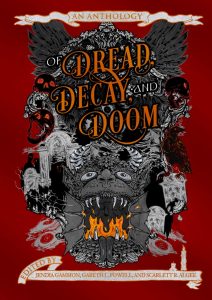
 Of Dread, Decay, and Doom
Edited by Jendia Gammon, Gareth L. Powell, and Scarlett R. Algee
Stars and Sabers Publishing (June 16, 2026)
Reviewed by Andrew Byers
Of Dread, Decay, and Doom is the third anthology from Stars and Sabers Publishing, the Los Angeles imprint run by Jendia Gammon (a Nebula and three-time BSFA finalist who also writes as J. Dianne Dotson) and British SF novelist Gareth L. Powell, here joined at the editorial desk by Scarlett R. Algee. The house’s first two outings, Of Shadows, Stars, and Sabers and Of Enchantment, Enigma, and the Infinite, ranged fairly widely across the speculative map. This one narrows the aperture to horror, and the result is a hefty, good-looking book of thirty-seven stories running better than four hundred pages.
The collection is arranged into three movements that echo the title—Dread, Decay, and Doom—and while I wouldn’t lean too hard on the divisions as a strict taxonomy, they do chart a rough tonal descent from the creeping and atmospheric toward the openly apocalyptic. The editors each contribute a short introduction, and Algee’s line about horror being “a monster or a memory, a scream or a whisper” is as good a one-sentence description of the book’s range as I could manage myself. This is not a themed anthology in the narrowest sense. It’s a broad church, and the contributors span several continents and a lot of subgenres.
That range is the anthology’s real selling point. Lee Murray’s “The Cleansing” opens on a woman cleared out of her job, wallowing on the couch with tea and chips, and Murray earns the horror by first getting the ordinary New Zealand domestic misery exactly right. Tim Waggoner’s “The World Has Teeth” mines dread out of that most American of settings, the late-night highway rest stop, and if you’ve ever pulled off the interstate at 2:30 in the morning and not liked the feel of the place, this one will stay with you. Eugen Bacon’s “The Defining Museum of Woomera” is the most formally adventurous piece in the book, an incantatory, Afro-surrealist prose poem of a story that some readers will find hypnotic and others will find hard going. At the other end of the register entirely, Chris Panatier’s “Glamhoppers” plays its horror for pitch-black laughs in a retirement community, and Vincent V. Cava’s “Killbilly Drive-Thru” is exactly the gleeful, fairy-tale-desecrating splatter the title promises.
A few pieces stuck with me for doing something I hadn’t seen done quite that way before. David Quantick’s “The Children of the Light” inverts the vampire story—his monster can only live in daylight and drinks sunlight out of people’s arteries—and Quantick, who has a long career in British comedy behind him, keeps it nasty and very funny at once. Eric Shanower’s “Courage” is the real curveball: an honest-to-goodness Oz story, and since Shanower has spent decades as one of the keepers of that flame, he has every right to send the Cowardly Lion up against a monstrous spider the size of an oak. Nicole Field’s “The Widow and the Raven” runs Mina Harker’s journal straight into Poe’s “The Raven,” a mashup that could have been a gimmick but instead lands its ending well. And Katrina Carruth’s “Telestial” tells a survival story in a frightened child’s clipped, nursery-rhyme cadence—the Scritch Scratchers and the Wail Whackers—that gets under the skin precisely because of how it’s told. I’ll also flag Patrick Barb’s “Did You Hear the One About the Girl with the Spider in Her Brain?” for having both the best title in the book and the body horror to back it up.
It would be dishonest, though, not to say what anyone who reads a lot of anthologies already knows: a book with three dozen stories in it is going to be a mixed bag, and this one is no exception. A handful of the middle entries struck me as competent without being especially memorable, the sort of thing that reads fine in the moment and evaporates by the next story. That’s the nature of the form, and it’s not really a knock—no anthology this size is all peaks—but readers who prefer a tightly curated dozen stories over a generous spread should know what they’re getting. What you’re getting here is quantity and quality, weighted toward the latter, with enough variety that almost everyone will find several new favorites and nobody will love all of it.
For my money, that’s a good trade. Of Dread, Decay, and Doom is a well-made, ambitious horror anthology with a genuinely international bench and a refreshing willingness to let its writers be strange. If you like your horror served in a wide variety of flavors—literary and pulpy, funny and bleak, cosmic and domestic—this is an easy one to recommend. I’ll be keeping an eye on what Stars and Sabers does next.

- Book Review: OF DREAD, DECAY, AND DOOM - September 27, 2026
- Book Review: GARGOYLE SAFARI - September 24, 2026
- Book Review: THE ASTRONAUT AMONG THE FLOWERS - September 22, 2026
- Book Review: CRAWL SPACE - July 21, 2026
- Book Review: CEMETERY TACOS AND OTHER DELIGHTS - July 13, 2026
- Book Review: OCTOBER SIGN ’22 - June 26, 2026
- Book Review: DARK ROOTS - May 21, 2026
- Book Review: EYE CONTACT - May 19, 2026
- Book Review: SNOW BLACK - May 15, 2026
- Book Review: ACOLYTES OF THE DEAD - April 28, 2026