Screenshot
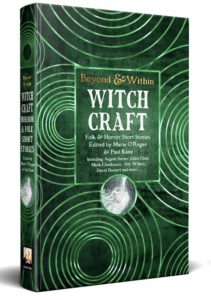
WITCHCRAFT
Marie O’Regan and Paul Kane, Eds.
Flame Tree Publishing (February 17, 2026)
Reviewed by Carson Buckingham
Witchcraft, another in Flame Tree Publishing’s Beyond and Within series, edited by Marie O’Regan and Paul Kane, had a lot of living up to do with the previously published volumes in this long line of excellence. And while the stories were well written, I really felt that the editors could have done better with their selections. There were only six stories out of the seventeen included that I would call excellent and that I really enjoyed. There was so much that could have been done as far as unique approaches to witchcraft go, and for the most part, it just wasn’t there. I’d have liked to have seen some off-the-wall treatments of this subject, for example: how about a sci-fi story with witches in space, or as astronauts? How about a witch as a modern-day schoolteacher who is burned in the parking lot by her students, and the fallout from that? A witch as a librarian who gives you the books you need, not the ones you ask for…until a man plotting murder comes for a book? A witch who owns a toy store and sells odd dolls that do interesting things? A witch policeman? Can a computer be a witch? Why not? How about a witch who has writer’s block and what she does about it? A witch in the Air Force? And how about some male witches? Some child witches? A witch stuck inside an animal? There were so many interesting tangents that could have been explored, and weren’t, that it stuck me as a missed opportunity to do something really unique with this age-old subject.
At any rate, this is only my opinion.
Here’s what you get:
“Apotropaic” by Ally Wilkes—This is a ‘witch in the woods’ story. The witch has a reputation for evil, but it is undeserved. It is the people who come to see her who have evil intentions. This is the first of the six that I thought was excellent.
“Stranded” by Eliza Chan—A witch, an old house she’s restoring, and an entitled woman who realizes what a mistake she made demanding to be let in out of the rain.
“Murder Ballads by Moonlight” by Angela Slatter – A young witch helps four dead girls deal with their killer. The second of the six that I thought was excellent.
“The Smokeless Fire” by Mark Chadbourne—A witch on the battlefield in Afghanistan teaches an NGO medic to walk with the Djinn.
“Wedding Planner” by Muriel Gray—A couple has rented an old, deconsecrated church for their wedding. But this church comes with a tradition in that any wedding held in it must also be attended by a paid ‘Guardian.’ The couple decides not to honor this tradition and save on the fee. They learn, too late, that they would have been better off spending the money. This is the third of the six that I thought was excellent.
“What Bones Remember” by Buhlebethu Sukoluhle Mpofu. A young kitchen witch is possessed by a Yaga (a Death Witch or Bone Witch), and she learns that death is not an ending but a transition.
“Jackie’s Dust” by Alison Moore—An eccentric woman in town becomes the center of talk and rumor, and urban legends spring up around her.
“Oro, Plata, Mata” by Gabriella Buba—A Filipino girl with a witch background tries to keep a low profile, until one of the island’s noblemen calls on her for help. She married into a wealthy family with a set of very strange stairs and a family curse.
“The Witch of Withered Hill”—by David Barnett—A witch outwits the Owd Hob—the spirit of Withered Hill, who demands a yearly sacrifice for good crops and fat cattle. A cute twist at the end.
“Catharsis” by Aveline Fletcher—A journey into Greek Mythology, with a tale of Circe, her niece Medea, and a lesson about remaining true to yourself, no matter what men tell you or believe of you.
“Remembrance” by Helen Grant—A youngish witch who has visions of the future tries to help a friend and gets more than they both bargained for.
“A Woman Grown” by Lisa L. Hannett—A lonely witch wants company and attempts to create life in a most unorthodox way, revealing something about how the witch herself came to be. This is the fourth of the six that I thought was excellent.
“The Stone Boat” by Melissa Bobe—Lupe is a coder who created the Nairn—to study and tame rogue magic. The story brings us gamer manifestations into the physical world. It had a great beginning, but a weak ending.
“Kittycat” by Amanda Mason—It’s better to live in a town that holds a vestige from the past that you hate, rather than none at all, and cave to modernity.
“The Tallow Feast” by Damien Kelly—After her mother dies, Alma makes tallow from her fat to use to summon powerful beings in an offering of a ‘meal’ of it in exchange for power. The witch she summons learns not to underestimate Alma. This is the fifth of the six that I thought was excellent.
“Flame Water Turns” by Eugen Bacon—Domestic violence and the pursuit of motherhood by a witch and her familiar.
“The Weaver” by Kay Hanifen—Be careful who you call a witch—it can have consequences. This is the sixth of the six that I thought was excellent. As a matter of fact, this one was my favorite of the entire book.
So, there you have it. And let me reiterate—not one of these stories is bad or poorly written, most of them just aren’t as interesting as I thought they could have been.
3.5 stars out of 5.

- Book Review: A CROW’S SCREAM - July 17, 2026
- Book Review: CEMETERY TACOS AND OTHER DELIGHTS - July 9, 2026
- Book Review: TOMBSTONES Series - June 12, 2026
- Book Review: WITCHCRAFT - April 30, 2026
- Book Review: THE NIGHT SHIP - February 19, 2026
- Book Review: THESE DREAMING SPIRES - February 17, 2026
- Book Review: THE FACE OF PAIN - February 9, 2026
- Book Review: KOLCHAK ERAS - February 5, 2026
- Book Review: HORROR LIBRARY, VOLUME 9 - February 4, 2026
- Book Review: FOX SPIRIT ON A DISTANT CLOUD - January 29, 2026